
CCNA Program Changes and Your Reaction: Keep Studying!
Cisco announced a complete revision to the entire career certification program on June 10th, 2019, with exams (lots and lots of exams) and new certifications and new rules and new everything with planned availability by February 2020. Yikes!
It took me a month to get over the shock when I first heard, and it will take you time as well. But after I had time to digest all the program changes, and the impact to all you CCNA R&S candidates out there, the conclusion was simple:
Studying for CCNA R&S? Don’t Worry about the Changes and Keep Studying!
In this post, I’ll tell you why I reached that conclusion, and in a similar post, I’ll tell you my thoughts based on the content of the new CCNA certification.
Quick Context
Were you pursuing CCNA R&S (or CCENT) when Cisco announced their sweeping redesign of Cisco career certifications on June 10, 2019? Then this post is for you. This post hits the big ideas, without too much detail, focusing on program changes that impact CCNA R&S.
I will revisit all of these topics over the coming weeks!
Also, I’m posting a similar blog post about the CCNA content rather than the certification program:
CCNA Content Changes and Your Reaction: Keep Studying!
Don’t Worry: 8.5 Month Transition
You have 8.5 months from the date of the announcements to complete your CCNA with the existing/old exams. That’s long enough for many of you to start now and finish before the current exams go away. The new exams (per pre-announce info) release Feb 24, 2020, with the old exams also going away that day.
In the past, Cisco has given as short as three months from the announce until the old exam went away. 8.5 months should not be a problem.
And if you do need more than 8.5 months, much of what’s in the current CCNA R&S survives to either the new CCNA or the new CCNP Core exam.
Don’t Worry: Credentials if You Pass w/ Old Exams
Keep studying, pass the existing exams (100-105, 200-105, 200-125), get your CCNA R&S before Feb 2020, and you will still have a Cisco CCNA Certification after the transition. Cisco will have a transition app to walk you through what you’ll have in terms of certifications after the transition. However, if you have CCNA R&S before Feb 2020, you will have a CCNA certification afterward.
Additionally, you will also potentially get something new called badges related to courses you might have taken and/or exams passed. (The pre-announce details on this point were fuzzy, and the website says the info about badges will be out neared the transition date.) Point is that you lose nothing by passing the old CCNA R&S (from a credentials perspective) and shouldn’t lose out on new credentials.
Don’t Worry: New CCNA as Good as Old CCNA Routing and Switching
On announce day, Cisco had 10 Associate-level certifications: nine CCNA certifications and one CCDA (same level, but about Design). All go poof in February 2020 per the June 2019 announcements, except CCNA Routing and Switching, which morphs into simply CCNA.

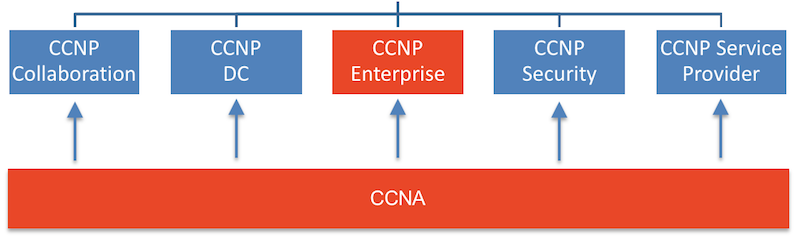
In the past, every time Cisco revved CCNA, CCNP, and so on, people wondered if Cisco had improved the real value and perceived value of that Cisco certification. I think it’s pretty clear this time, thinking solely about CCNA R&S vs the new CCNA, that the perceived value will be improved, is at least the same, and probably much more. As mentioned in my first 5 facts post this week, even though CCNA certification is not a prerequisite, CCNA sets the foundation for the other CCNP certifications, in particular, CCNP Enterprise (which replaces CCNP Route/Switch).
Don’t Worry: More Exam Options Today vs. Future CCNA
The announcement does make this noticeable change to CCNA R&S: The 2-exam path to CCNA R&S will disappear. (Currently, you can take/pass the ICND1 100-105 and ICND2 200-105 exams to get your CCNA R&S certification, or pass the CCNA 200-125 exam, either way.) So, for those of you pursuing CCNA R&S now, you actually have more options today. Pick the one that suits your preference.
Note that having a one-exam path only for the new CCNA should not be a big barrier: the new CCNA is roughly 25% smaller than the old CCNA R&S by the best objective measurements I can make (course lengths, book page count, that sort of thing.)
CCNA R&S (or CCNA) as an End Goal
Were you pursuing CCNA R&S certification as the goal itself? If so, you can pass either the old exams or new. No reason to wait – just keep working. You’ll have three years then to receertify, with the new rules beginning Feb 24, 2020, which give you many more recertification options compared to today.
CCNA R&S (or CCNA) as a Means to an End
Were you pursuing CCNA R&S certification as a means to an end, for instance, because it is a prerequisite for CCNP R&S? There is a change that matters to you:
- CCNA certification is no longer a prerequisite for CCNP Enterprise (which replaces CCNP R&S) with the new program.
- CCNA knowledge is definitely required for CCNP Enterprise (and parts of CCNA are needed for some other CCNP certifications.)
If your real goal is CCNP R&S, you may decide to not take the CCNA R&S exam. But you still need the CCNA R&S knowledge before you can learn about CCNP R&S (or in the future, CCNP Enterprise). So from the perspective of what to do in the short term, keep studying!
Your Choice: Pass Now or Wait
You can choose to keep marching towards CCNA R&S, planning to pass by February 2020. You can study now with an eye towards passing the new exam. But I don’t see any downside related to the Cisco program changes for studying for the existing CCNA. Maybe you see the changes differently, so feel free to comment or tweet me about it.
And stay tuned – I’ll post a few more of these here in announcement week, and keep blogging about it for a few more months, and again as the 8-month transition moves along!