
Config Lab: IPv4 Addresses 3
With enough repetition, you should be able to imagine a small network of routers, choose a subnetting plan, choose addresses for the router interfaces, and configure those addresses, all pretty much as fast as you can write or type. This latest config lab exercise helps you practice towards that goal. It lists a subnetting design and asks you to find the lowest IP addresses in each of six subnets and configure the addresses on Cisco router interfaces. Details below the fold. Enjoy!

The Lab Exercise
Requirements
The following figure shows a simple internetwork with three routers. The figure also lists one IP address in six different subnets. These IP addresses are not the IP addresses used by the routers. Instead, these IP addresses are part of the subnets you should use for your configuration. First, you have to do some math.
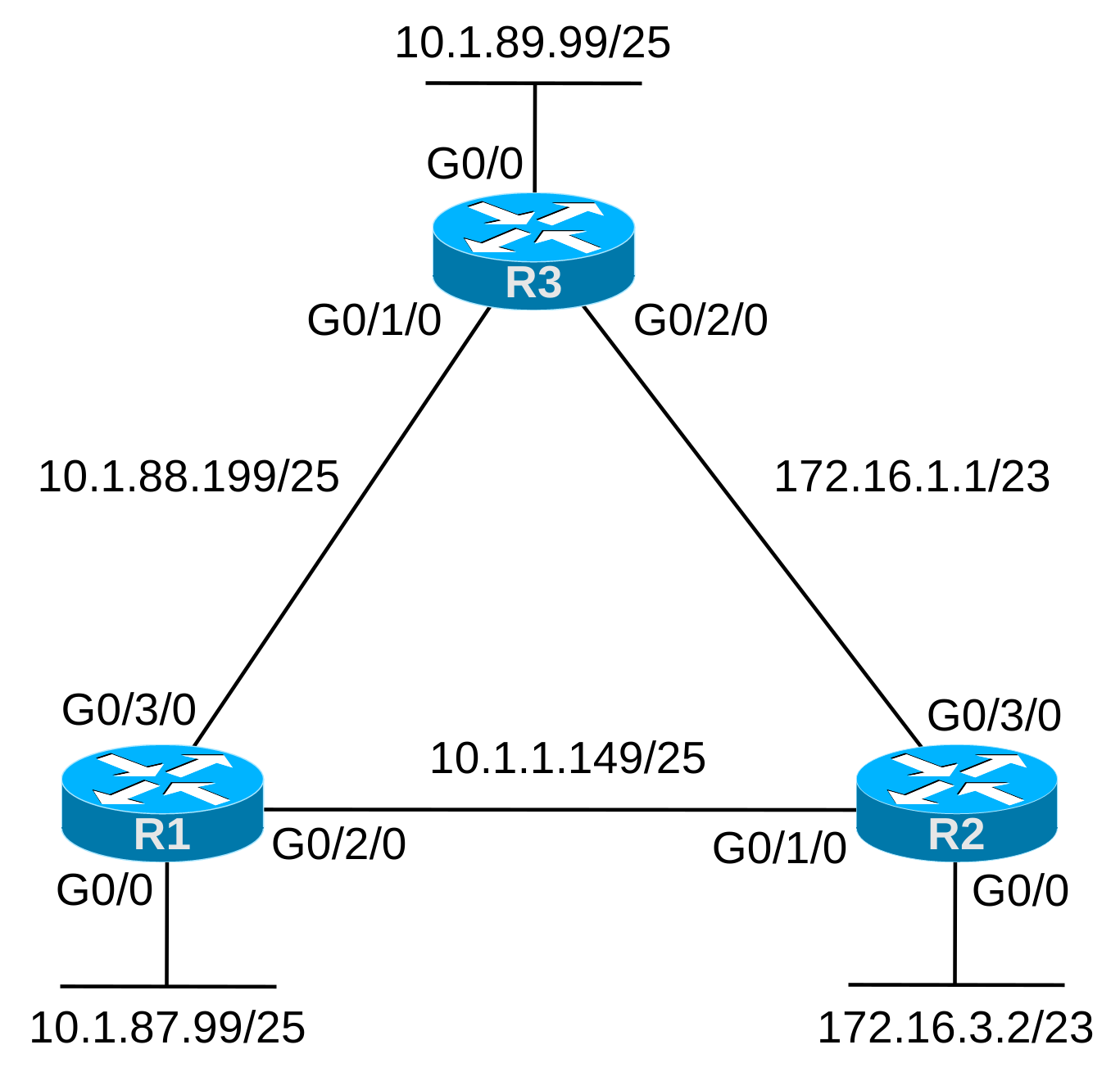
Figure 1:Topology and Subnets for this Lab
Your jobs and rules:
- Calculate the numerically lowest IP addresses in each subnet based on the information in the figure.
- Configure the routers to:
- Bring up their interfaces.
- Use the lowest IP address in each subnet.
- For the subnets that include two routers, assign the lower-numbered router the lower IP address value.
- Each router should be able to successfully ping its three own IP addresses when complete.
- Use defaults unless absolutely necessary.
Initial Configuration
Assume that the routers have no configuration to begin the lab other than their hostnames.
Answer Options - Click Tabs to Reveal
You can learn a lot and strengthen real learning of the topics by creating the configuration – even without a router or switch CLI. In fact, these labs were originally built to be used solely as a paper exercise!
To answer, just think about the lab. Refer to your primary learning material for CCNA, your notes, and create the configuration on paper or in a text editor. Then check your answer versus the answer post, which is linked at the bottom of the lab, just above the comments section.
You can also implement the lab using the Cisco Packet Tracer network simulator. With this option, you use Cisco’s free Packet Tracer simulator. You open a file that begins with the initial configuration already loaded. Then you implement your configuration and test to determine if it met the requirements of the lab.
(Use this link for more information about Cisco Packet Tracer.)
Use this workflow to do the labs in Cisco Packet Tracer:
- Download the .pkt file linked below.
- Open the .pkt file, creating a working lab with the same topology and interfaces as the lab exercise.
- Add your planned configuration to the lab.
- Test the configuration using some of the suggestions below.
This Lab Supports Both CML-Free and CML-Personal!!!
The downloadable file listed here works in both CML-P or CML-F because it uses the IOL (router) and IOL-L2 (switch) reference platform images supported by both products as of CML V2.8. Note that these images also require less CPU and RAM than the other CML-P options.
Use the same general workflow as with Cisco Packet Tracer, as follows:
- Download the CML file (filetype .yaml) linked below.
- Import the lab’s CML file into CML.
- Start the lab in CML.
- Compare the CML lab topology and interface IDs to this lab Blog page, as they may differ (more detail below).
- Add your planned configuration to the lab, adjusting for interface ID differences.
- Test the configuration using some of the suggestions below.
Interface ID Differences:
The lab diagrams on this page use interface IDs (IIDs) that match the Packet Tracer version of the lab. When using CML, adjust the lab IIDs based on this table. Also, note that the IOL and IOL-L2 images used by the supplied CML file support only the “Ethernet” interface type, and not “FastEthernet” or “GigabitEthernet”.
The conventions for this lab are:
- All Gigabit interfaces convert to Ethernet interfaces.
- IID G0/0 converts to E0/0.
- IIDs in the pattern G0/x/0 convert to E0/x. For example, G0/1/0 becomes E0/1.
The following table details all combinations of IID changes for this lab.
| Lab Port | CML Port |
| G0/0 | E0/0 |
| G0/1/0 | E0/1 |
| G0/2/0 | E0/2 |
| G0/3/0 | E0/3 |
Config Lab Review Video
The above lab intro – the text, figures, and initial configuration – tells you all you need to know. But if you want a little more, with a little different slant on what to do in this lab, watch this lab intro video!
Lab Answers Below: Spoiler Alert
Lab Answers: Configuration (Click Tab to Reveal)
Answers
To find the lowest IP addresses, calculate the subnet ID, and then add 1 in the 4th octet. I won’t go into how to find the subnet ID – that’s all over the books – but I’ll entertain specific questions if you have them. Then you just need to configure the IP addresses using the ip address address mask interface subcommand, as shown here.
Figure 1: Three Router Topology w/ Sample IP Addresses for Calculations
interface GigabitEthernet0/0
 no shutdown
 ip address 10.1.87.1 255.255.255.128
!
interface GigabitEthernet0/2/0
 no shutdown
 ip address 10.1.1.129 255.255.255.128
!
interface GigabitEthernet0/3/0
 no shutdown
 ip address 10.1.88.129 255.255.255.128
Example 1: R1 Config
interface GigabitEthernet0/0
 no shutdown
 ip address 172.16.2.1 255.255.254.0
!
interface GigabitEthernet0/1/0
 no shutdown
 ip address 10.1.1.130 255.255.255.128
!
interface GigabitEthernet0/3/0
 no shutdown
 ip address 172.16.0.1 255.255.254.0
Example 2: R2 Config
interface GigabitEthernet0/0
 no shutdown
 ip address 10.1.89.1 255.255.255.128
!
interface GigabitEthernet0/1/0
 no shutdown
 ip address 10.1.88.130 255.255.255.128
!
interface GigabitEthernet0/2/0
 no shutdown
 ip address 172.16.0.2 255.255.254.0
Example 3: R3 Config
Commentary, Issues, and Verification Tips (Click Tabs to Reveal)
Before configuring any commands for this lab, you needed to plan your IP addresses. In this case, the figure shows the subnet IDs, and you have to find the numerically lowest address(es) to use for the routers. That makes the math pretty easy – just add one to the 4th octet of the subnet ID to get the numerically lowest IP address in the subnet.
Once planned, configuring the IP addresses require one command per interface: the ip address address mask command, with the address and dotted-decimal mask used as the two parameters.
Finally, for this lab, you should have considered adding the no shutdown command to each interface. The lab states that the routers have no configuration other than the hostname command. As a result, the interfaces may be in an administratively disabled (shutdown) state to begin the lab. The no shutdown command would then change the state to administratively enabled.
Known Issues in this Lab
This section of each Config Lab Answers post hopes to help with those issues by listing any known issues with Packet Tracer related to this lab. In this case, the issues are:
| # | Summary | Detail |
| 1 | None | No known issues related to this lab. |
Why Would Cisco Packet Tracer Have Issues?
(Note: The below text is the same in every Config Lab.)
Cisco Packet Tracer (CPT) simulates Cisco routers and switches. However, CPT does not run the same software that runs in real Cisco routers and switches. Instead, developers wrote CPT to predict the output a real router or switch would display given the same topology and configuration – but without performing all the same tasks, an actual device has to do. On a positive note, CPT requires far less CPU and RAM than a lab full of devices so that you can run CPT on your computer as an app. In addition, simulators like CPT help you learn about the Cisco router/switch user interface – the Command Line Interface (CLI) – without having to own real devices.
CPT can have issues compared to real devices because CPT does not run the same software as Cisco devices. CPT does not support all commands or parameters of a command. CPT may supply output from a command that differs in some ways from what an actual device would give. Those differences can be a problem for anyone learning networking technology because you may not have experience with that technology on real gear – so you may not notice the differences. So this section lists differences and issues that we have seen when using CPT to do this lab.
Known Issues in this Lab w/ CML
This tab lists known issues with running this lab in CML with the supplied file. The issues are:
| # | Summary | Detail |
| 1 | Interfaces may begin lab in a shutdown state. | Due to oddities in the application of defaults of the shutdown/no shutdown commands, your router interfaces may initialize in the shutdown state. To remedy, use the no shutdown interface subcommand on each interface shown to be used in the lab. |
Why Would CML Have Issues?
(Note: The text below is the same as every Config Lab.)
CML supports a variety of Cisco operating systems (called reference platforms.) To make them work in CML, Cisco makes some adjustments to the code. Also, because no real router or switch hardware exists, some software features do not work the same when running in CML versus a real Cisco device. When we come across any difference when testing the lab, we’ll try to leave a note just above in case it helps you with the lab.
Beyond comparing your answers to this lab’s Answers post, you can test in Cisco Packet Tracer (CPT) or Cisco Modeling Labs (CML). In fact, you can and should explore the lab once configured. For this lab, once you have completed the configuration, try these verification steps.
- From the console of each router, verify the router’s IP addresses:
- Use the show ip interface command to verify the address and mask.
- Use the show ip interfaces brief command to verify the addresses.
- Use the ping command against the addresses expected to be configured on the local router; all pings should work.
- The initial configuration does not include any routing protocol configuration, so you should see only connected and local routes in the routing tables unless you chose to add routing protocol configuration. You can verify those routes as compared to the figure. On each router:
- Use the show ip route command. Look for three connected routes, one for each router interface per the figure.
- Use ping tests to ping the router IP addresses on the opposite end of each WAN link:
- From router R1, ping the R2 WAN IP address on their shared link and then the R3 WAN IP address on their shared link.
- Likewise, from router R2, ping R1’s WAN IP address and R3’s WAN IP address.
- Finally, from R3, ping R1’s and R2’s WAN IP addresses on the respective shared links.
Config Lab Review Video
Want to hear more about this lab’s solution? Check out the video to the left.